


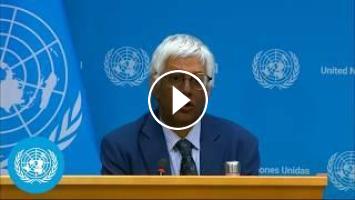
Noon briefing by Farhan Haq, Deputy Spokesperson for the Secretary-General.
Highlights:
- Secretary-General/Trip Announcement
- Critical Energy Transition Minerals
- Iran
- Yemen
- Lebanon
- Occupied Palestinian Territory
- Security Council
- Sudan
- Democratic Republic of the Congo/Humanitarian
- Democratic Republic of the Congo
- Noon Briefing Guest
- Financial contribution
SECRETARY-GENERAL/TRIP ANNOUNCEMENT
Tomorrow, the Secretary-General will start a visit to China, where he will have several official engagements. During the visit, the Secretary-General will travel to Yunnan Province. He will visit the Erhai Lake Ecological Corridor in Dali, a 900-hectare nature-based restoration project that has significantly boosted local biodiversity. Afterwards, in Kunming, he will interact with beneficiaries and local counterparts of UN programmes supporting the achievement of the Sustainable Development Goals in China. Among these are programmes on biodiversity conservation and ecosystem restoration, low-carbon rural development and sustainable agriculture, rural revitalization, as well as gender equality and social inclusion.
While in China, the Secretary-General will also attend the Opening Ceremony of the World AI Conference in Shanghai. In his address, he will emphasize that the defining question is not whether artificial intelligence will transform our world, but whether that transformation will reduce inequalities and expand opportunity. The Secretary-General is expected to underscore that the technology that will shape the future of humanity must be shaped by all of humanity, and that it cannot be governed by a handful of countries or companies. The Secretary-General will also deliver remarks at the Opening Session of the World AI Conference Meteorological Forum.
The Secretary-General will return to New York on Monday, 20 July.
CRITICAL ENERGY TRANSITION MINERALS
This morning, the Deputy Secretary-General, Amina Mohammed, addressed a High-Level Meeting on Critical Energy Transition Minerals. She stressed that advancing the energy transition, at speed and scale, has never been more urgent or vital.
Ms. Mohammed noted that the climate crisis is driving us deeper into planetary overshoot with rising temperatures pushing us closer to irreversible catastrophic tipping points. And at the same time, she added, a global energy crisis is exposing the folly of a world still hooked on hydrocarbons, with limited access to cleaner fuels for the poor, and accelerated destruction of our natural systems, pushing ecosystems to the brink.
The Deputy Secretary-General pointed out that these crises have one common cause: fossil fuels. She underscored that they demand the same answer: a fast, fair and inclusive transition to clean energy, along with shared benefits from decarbonization, and a surge in adaptation finance, resilient infrastructure and climate justice for those already facing climate harm.
Full Highlights: https://www.un.org/sg/en/content/noon-briefing-highlight?date=2026-07-14
Highlights:
- Secretary-General/Trip Announcement
- Critical Energy Transition Minerals
- Iran
- Yemen
- Lebanon
- Occupied Palestinian Territory
- Security Council
- Sudan
- Democratic Republic of the Congo/Humanitarian
- Democratic Republic of the Congo
- Noon Briefing Guest
- Financial contribution
SECRETARY-GENERAL/TRIP ANNOUNCEMENT
Tomorrow, the Secretary-General will start a visit to China, where he will have several official engagements. During the visit, the Secretary-General will travel to Yunnan Province. He will visit the Erhai Lake Ecological Corridor in Dali, a 900-hectare nature-based restoration project that has significantly boosted local biodiversity. Afterwards, in Kunming, he will interact with beneficiaries and local counterparts of UN programmes supporting the achievement of the Sustainable Development Goals in China. Among these are programmes on biodiversity conservation and ecosystem restoration, low-carbon rural development and sustainable agriculture, rural revitalization, as well as gender equality and social inclusion.
While in China, the Secretary-General will also attend the Opening Ceremony of the World AI Conference in Shanghai. In his address, he will emphasize that the defining question is not whether artificial intelligence will transform our world, but whether that transformation will reduce inequalities and expand opportunity. The Secretary-General is expected to underscore that the technology that will shape the future of humanity must be shaped by all of humanity, and that it cannot be governed by a handful of countries or companies. The Secretary-General will also deliver remarks at the Opening Session of the World AI Conference Meteorological Forum.
The Secretary-General will return to New York on Monday, 20 July.
CRITICAL ENERGY TRANSITION MINERALS
This morning, the Deputy Secretary-General, Amina Mohammed, addressed a High-Level Meeting on Critical Energy Transition Minerals. She stressed that advancing the energy transition, at speed and scale, has never been more urgent or vital.
Ms. Mohammed noted that the climate crisis is driving us deeper into planetary overshoot with rising temperatures pushing us closer to irreversible catastrophic tipping points. And at the same time, she added, a global energy crisis is exposing the folly of a world still hooked on hydrocarbons, with limited access to cleaner fuels for the poor, and accelerated destruction of our natural systems, pushing ecosystems to the brink.
The Deputy Secretary-General pointed out that these crises have one common cause: fossil fuels. She underscored that they demand the same answer: a fast, fair and inclusive transition to clean energy, along with shared benefits from decarbonization, and a surge in adaptation finance, resilient infrastructure and climate justice for those already facing climate harm.
Full Highlights: https://www.un.org/sg/en/content/noon-briefing-highlight?date=2026-07-14
- Category
- Policy & Governance
- Tags
- UN, United Nations, UNGA

Be the first to comment
Up Next
Autoplay
-
27:35

AI, Finances, Peacekeeping & other topics - Daily Press Briefing (1 July 2026) | United Nations
-
33:14
AI Governance, Sudan & other topics - Daily Press Briefing (6 July 2026) | United Nations
-
High-Level Political Forum, Iran & other topics -Daily Press Briefing (13 July 2026)| United Nations
-
29:24
Iran, Lebanon & other topics - Daily Press Briefing (30 April 2026) | United Nations
-
23:42
Yemen, Lebanon & other topics - Daily Press Briefing | United Nations
-
15:47
Venezuela, Lebanon & other topics - Daily Press Briefing (7 July 2026) | United Nations
-
26:55
Haiti, Lebanon & other topics - Daily Press Briefing (23 April 2026) | United Nations
-
27:17
Lebanon, UAE, Sudan & other topics - Daily Press Briefing (5 May 2026) | United Nations
-
Lebanon/Israel, Sudan, Ebola & other topics - Daily Press Briefing (9 July 2026) | United Nations
-
20:38
Ukraine, Lebanon & other topics - Daily Press Briefing (12 June 2026) | United Nations
-
06:24

Netherlands vs Japan Predictions ???? FIFA World Cup 2026 Betting Preview
 Loading...