


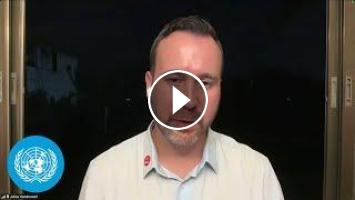
The United Nations press conference featuring Julius Van Der Walt, Chief of the UN Mine Action Programme (UNMAS) in the Occupied Palestinian Territory. He briefed on the humanitarian impact of unexploded ordnance (EO) and related access issues in Gaza and the West Bank. Explosive remnants from conflict create ongoing dangers. They kill and injure civilians daily, block aid, and slow recovery in heavily damaged areas.
The problem is not just "leftover bombs." It is structural: widespread contamination in a small geographic area (roughly one dangerous item every 600 meters in Gaza), severe underreporting due to displacement and weak data systems, and constraints on clearance operations. A recent EU-UN-World Bank rapid damage and needs assessment (RDNA) highlights that 1.9 million of Gaza's 2.1 million people are displaced, 60% lack homes, and human development has been set back 77 years.
The surface framing ("post-conflict cleanup") benefits parties avoiding responsibility for the scale of contamination or the political barriers to full mine action. It obscures how access restrictions, security conditions, and dual-use equipment limits (detectors, demolitions, explosives) prevent scaling up clearance. Humanitarian actors and civilians bear the immediate costs; political actors face less pressure to resolve underlying access and security issues that keep recovery stalled.
- Casualties: Over 1,200 verified killed or injured by EO in Gaza since October 2023 (average ~1 per day). Nearly half are children. Figures are underreported. Save the Children data notes tens of thousands of child injuries, with Gaza having the world's largest group of child amputees.
- Daily life: Families cannot safely return home or rebuild. Farmers cannot cultivate land. Aid convoys face risks. Children and communities live in constant fear.
- Broader impact: Hinders humanitarian response, early recovery, and reconstruction. In the West Bank, increased EO in refugee camps and cities compounds vulnerabilities for Bedouin and IDP communities.
UNMAS has trained personnel and expertise ready to expand operations (explosive hazard assessments, route clearance, risk education, accompanying missions). Partners like WFP, WHO, and Oxfam have seen tangible benefits from limited interventions. However, security conditions, access restrictions, and lack of technical equipment (especially dual-use items) constrain scaling. Origin of EO varies (different countries, conventional and improvised), complicating attribution but not the universal risk to civilians. Full clearance is a long-term process requiring sustained political will and resources.
Clearing EO is a foundational step for any recovery or peace process, it enables safe aid delivery, return, and rebuilding. A decent response prioritizes expanding mine action now to reduce future harm. The smallest first step is removing barriers to equipment and access so UNMAS and partners can operate at the scale the contamination demands.
This briefing aligns with broader sustainable development mechanisms like the 2030 Agenda (SDGs), particularly SDG 16 (peaceful societies, access to justice, strong institutions) and cross-cutting goals on poverty, health, and reduced inequalities. Contamination directly undermines "leaving no one behind" in post-conflict settings.
Sources
- West Bank and Gaza Press Conference (UN Web TV / YouTube, 1 May 2026): https://www.youtube.com/watch?v=XvvCHUqq33o
- UNISPAL Document Summary: https://www.un.org/unispal/document/press-conference-julius-van-der-walt-unmas-on-the-situation-in-the-west-bank-and-gaza-as-it-concerns-unexploded-ordnance-and-access/
- A/RES/70/1 Transforming our world: the 2030 Agenda for Sustainable Development: https://sdgs.un.org/2030agenda
- Category
- United Nations
- Tags
- UN, United Nations, UNGA, UNMAS, explosive ordnance, Gaza contamination, West Bank, humanitarian access, child casualties, mine action

Up Next
-
31:05

Lebanon, UNIFIL, West Bank & other topics - Daily Press Briefing (29 April 2026) | United Nations
-
22:56
Occupied West Bank : Witnessing Life & Insecurity | Security Council Briefing | United Nations
-
29:05
Gaza: Humanitarian Situation - Press Conference | United Nations
-
06:49
Palestine on the West Bank - Security Council Media Stakeout | United Nations
-
30:22
Health Situation in Gaza - Press Conference | United Nations
-
21:44
The situation in Gaza - Press Conference | United Nations
-
07:55
Palestine on the West Bank II - Security Council Media Stakeout | United Nations
-
06:37
E5 on West Bank and East Jerusalem - Media Stakeout | United Nations
-
16:25
Gaza: Humanitarian Situation - Press Conference | United Nations
-
11:49
Middle East: Situation in Gaza & West Bank steadily worsening - Briefing | United Nations
-
00:16

How to Implement Stoicism in Self Care
-
02:08

Unleashing Your Potential The Power of Self-Development
-
01:00
Prioritize You: Mental Health and Self-Care
-
03:00

Personal Development vs Magical Growth | #magic #occult
-
00:16
Perpetual Self-Improvement #personalgrowth #selfgrowth #continuouslearning #personaldevelopment
-
00:07
How to Use Personal Development to Improve Your Life #personaldevelopment #businessowner #growth
-
00:11
Personal Development | Motivational Facts #131
-
16:31

Building Confidence & Self Esteem as An Introvert || Personal Development
-
00:14
Jim Rohn - Income does not far exceed personal development
-
01:19
Andy Britnell Personal Development Videos - putting on a successful presentation
 Loading...