


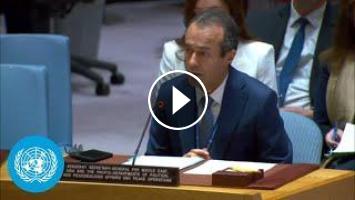
The video is a short UN Security Council briefing (from around May 2024) by Khaled Khiari, Assistant Secretary-General for Middle East, Asia and the Pacific in the Departments of Political and Peacebuilding Affairs and Peace Operations.
DPRK (North Korea) conducted a launch of a military reconnaissance satellite using ballistic missile technology. The UN and member states view this as a violation of Security Council resolutions that ban DPRK's ballistic missile activities.
The launch was not a peaceful space effort. It used prohibited ballistic missile technology, which doubles as a delivery system for nuclear weapons. This fits a pattern of repeated tests that escalate tensions on the Korean Peninsula.
DPRK benefits by advancing its nuclear and missile capabilities under the cover of a "satellite" program. The lack of unified Security Council action allows this pattern to continue without strong collective pushback. Regional actors (South Korea, Japan, US) face direct security risks, while broader international norms on non-proliferation weaken.
These launches threaten civil aviation and maritime traffic in the region. They divert resources from meeting the basic needs of DPRK's people. Continued escalation blocks diplomatic space for cooperation that could address poverty, food security, and development challenges tied to the 2030 Agenda.
The documents you shared (the full 2030 Agenda resolution, committee practices, and related materials) underscore the tension. The Agenda calls for peaceful, inclusive societies (Goal 16) and global partnership (Goal 17), but ballistic missile programs undermine the stability needed to deliver on poverty reduction, health, education, and environmental goals.
DPRK argues its actions are defensive responses to external threats and exercises its sovereign right to space technology. Sanctions and isolation have not stopped the program, and some might argue engagement offers a better path than confrontation.
A decent response prioritizes de-escalation to protect regional peace and open doors for humanitarian and development cooperation. The smallest first step is sustained diplomatic pressure paired with readiness to support the DPRK people once verifiable steps toward denuclearization occur.
This briefing mechanism shows how one prohibited action ripples into broader instability, directly complicating the integrated, indivisible approach the 2030 Agenda demands.
Sources
- A/RES/70/1. Transforming our world: the 2030 Agenda for Sustainable Development: https://sdgs.un.org/2030agenda
- UN News on DPRK launch risks: https://news.un.org/en/story/2023/11/1144012
- Video briefing source: https://www.youtube.com/watch?v=kc0VrXY9twk

Up Next
-
11:31

Life in DPR Korea still ‘daily struggle devoid of hope’ warns human rights chief | Security Council
-
52:01
(Full) Russia Vetoes Security Council Resolution Meant to Monitor UN Sanctions in DPR Korea
-
04:19
Switzerland on Non-Proliferation: DPR of Korea - Media Stakeout | Security Council | United Nations
-
03:07
U.S., Japan, and Republic of Korea on Women, Peace, and Security | Security Council | United Nations
-
04:01
U.S., Australia, Canada and others on DPR Korea - Media Stakeout | Security Council | United Nations
-
48:22
Republic of Korea on the Programme of Work of the Security Council for June | United Nations
-
04:25
Non-proliferation: DPRK continued ballistic missile launches - DPPA Briefing | United Nations
-
04:01
Republic of Korea delivers joint statement on human rights in DPRK - Security Council Media Stakeout
-
04:49
Joint Stakeout on DPR Korea arms transfers - Security Council Media Stakeout | United Nations
-
05:03
Republic of Korea on Climate, Peace & Security - Joint Security Council Media Stakeout | UN
-
06:24

Netherlands vs Japan Predictions ???? FIFA World Cup 2026 Betting Preview
 Loading...