


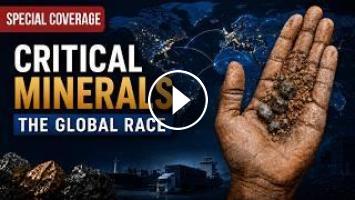
The phone in your hand runs on minerals most people can't name - but who benefits from extracting them, and who pays the price?
Kaveh Madani, Director of the UN University Institute for Water, Environment and Health (UNU-INWEH), explains what critical minerals are, why supply chain disruptions carry major economic and security consequences, and how the absence of global governance risks creating new "sacrifice zones" - communities left with pollution and human rights violations while the benefits flow elsewhere.
From extraction to electronic waste, he sets out what governments, companies and consumers can each do to make these supply chains fairer and more transparent.
#NaturalResources #ConflictMinerals #CriticalMinerals #DRC #SecurityCouncil #Peacebuilding #unitednations
0:00 The minerals behind our technology
0:09 What are critical minerals?
0:20 Why are they "critical"?
0:38 Who gains — and who pays
1:01 The governance gap and "sacrifice zones"
1:21 What governments and consumers can do
Kaveh Madani, Director of the UN University Institute for Water, Environment and Health (UNU-INWEH), explains what critical minerals are, why supply chain disruptions carry major economic and security consequences, and how the absence of global governance risks creating new "sacrifice zones" - communities left with pollution and human rights violations while the benefits flow elsewhere.
From extraction to electronic waste, he sets out what governments, companies and consumers can each do to make these supply chains fairer and more transparent.
#NaturalResources #ConflictMinerals #CriticalMinerals #DRC #SecurityCouncil #Peacebuilding #unitednations
0:00 The minerals behind our technology
0:09 What are critical minerals?
0:20 Why are they "critical"?
0:38 Who gains — and who pays
1:01 The governance gap and "sacrifice zones"
1:21 What governments and consumers can do
- Category
- Policy & Governance
- Tags
- UN, United Nations, UNGA

Be the first to comment
Up Next
Autoplay
-
01:00

UN Pays Tribute to Legacy of Anne Frank | United Nations
-
21:56
Briefing by the United Nations High Commissioner for Refugees | United Nations
-
21:51
Gracelin Baskaran on the Race for Minerals
-
06:46
2006 World Cup Classic for the Price of a LASK Ticket
-
49:20
IMO Pauses Strait of Hormuz Evacuation: Seafarers and Global Supply Chains Pay the Price
-
12:15
Children Continue to Pay Terrible Price in Multiple Conflicts | Ban Ki-Moon | Security Council
-
02:32
UN Chief at UNEA-6 | United Nations Environment Assembly | United Nations
-
01:28
Gaza: WHO Transfers Critical Patients from Northern Hospitals | News Flash | United Nations
-
02:22
‘Ambassadors of the Cosmos’ arrive at the United Nations | Artemis II | United Nations
-
00:54
The First Lady and the Executive Residence Staff Prepare for The Crown Price of Saudi Arabia's Visit
-
06:24

Netherlands vs Japan Predictions ???? FIFA World Cup 2026 Betting Preview
 Loading...