


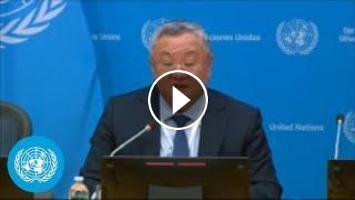
China took over the rotating presidency of the UN Security Council for May 2026. Ambassador Fu Cong outlined priorities focused on upholding the UN Charter, addressing Middle East hotspots, supporting African stability, and improving Council operations.
The briefing is procedural and diplomatic. It presents China's leadership as constructive and multilateral, while advancing specific national and regional interests (e.g., emphasis on Gaza ceasefire, two-state solution, and criticism of certain actions). It frames current global tensions as failures to uphold the Charter rather than flaws in the system itself.
- China gains visibility as Council president, hosting a high-level debate and shaping the agenda on Charter principles and hotspots.
- UNSC members (especially permanent ones) maintain influence through consensus-based work.
- Global South countries are highlighted as beneficiaries of China's support for development and non-interference approaches.
- Beneficiaries of the surface narrative include those favoring multilateral forums over bilateral power plays; critics see it as rhetorical cover for specific geopolitical stances (e.g., on Iran, Palestine, or great-power relations).
Ongoing conflicts in Gaza, Lebanon, Syria, and parts of Africa continue to exact tolls: civilian deaths, humanitarian crises, eroded livelihoods, and displacement. The briefing stresses the need for ceasefires, humanitarian access, and protection of civilians and peacekeepers, but progress depends on parties' compliance. Delays in de-escalation prolong suffering for ordinary people caught in these zones.
China's emphasis on Charter principles and multilateralism is standard diplomatic language, but implementation often collides with sovereignty concerns and differing interpretations among members. Great-power competition (e.g., China-US dynamics) can limit Council effectiveness regardless of the presiding nation. The call for "African solutions to African problems" and non-zero-sum relations with the US are aspirational; real outcomes hinge on trust and enforcement mechanisms that remain weak.
A decent approach is to support transparent Council work that prioritizes de-escalation and civilian protection while recognizing the limits of any single presidency. Small first step: Track the May 26 high-level open debate on the UN Charter for concrete commitments to dialogue over escalation.
Sources
- China: President of the Security Council for the month of May 2026 - Press Conference | United Nations: https://www.youtube.com/watch?v=789aARC7mKU
- A/RES/70/1, Transforming our world: the 2030 Agenda for Sustainable Development (2015): Multiple provided PDFs and UN pages (e.g., https://sdgs.un.org/2030agenda)

Up Next
-
00:44

Russia and China Veto U.S. Ceasefire Resolution for Gaza | Security Council | United Nations
-
49:38
UN Security Council Welcomes Five New Non-Permanent Members for 2026–2027 | United Nations
-
50:02
The World Economic Situation and Prospects Report 2026 - DESA | Press Conference | United Nations
-
41:29
China: Security Council President for February 2025 - Press Conference | United Nations
-
10:52
Western Sahara: Security Council Renewal of UN Mission - Press Conference | United Nations
-
President Trump Holds a Press Conference, Jun. 17, 2026
-
26:23
South Sudan Integrated Food Security Phase Classification Report - Press Conference | United Nations
-
09:43
Syria on the situation in the country - Security Council Stakeout (24 April 2026) | United Nations
-
53:15
UN Security Council’s November 2025 Agenda - Press Conference | United Nations
-
01:19
Malta (Security Council President) on the Admission of New Members to the Council | United Nations
-
00:16

How to Implement Stoicism in Self Care
-
02:08
Unleashing Your Potential The Power of Self-Development
-
01:00

Prioritize You: Mental Health and Self-Care
-
03:00

Personal Development vs Magical Growth | #magic #occult
-
00:16

Perpetual Self-Improvement #personalgrowth #selfgrowth #continuouslearning #personaldevelopment
-
00:07

How to Use Personal Development to Improve Your Life #personaldevelopment #businessowner #growth
-
00:11
Personal Development | Motivational Facts #131
-
16:31
Building Confidence & Self Esteem as An Introvert || Personal Development
-
00:14
Jim Rohn - Income does not far exceed personal development
-
01:19

Andy Britnell Personal Development Videos - putting on a successful presentation
 Loading...